Circular window for St Marks, Camden Town Contemporary window in Arts & Crafts style Detailed from Westminster Abbey stained glass window Stained glass windows

Stained Glass | Bespoke Leaded & Mouth-Blown Glass Windows

Stained glass is one of architecture’s oldest and most expressive forms of coloured light. At Andrew Moor Associates we design and make architectural stained glass using mouth-blown glass, hand painting and traditional leadwork, for churches, synagogues, heritage buildings and carefully chosen contemporary interiors.

How stained glass is made

Each window starts with a full-size design. Mouth-blown glass is chosen for colour and texture, cut precisely to the pattern, then painted with detail and shading. The painted pieces are fired in a kiln to fuse the paint permanently to the glass, then assembled with lead strips, soldered and sealed. Mouth-blown glass carries subtle variations in colour and texture that machine-made glass cannot reproduce, which is why light passing through a stained glass window feels so alive.

New windows and copies of existing windows

Every window we make is designed for its building and the way people use it. New commissions give us freedom to create original imagery and colour, from traditional sacred themes to contemporary compositions. We can also copy existing windows, studying the original design, glass colours and painting style so that the new window matches it closely and sits comfortably in its setting.

Where stained glass works best

Stained glass is most at home in sacred spaces and heritage settings, where craft and symbolism carry real meaning. It also works in contemporary interiors, such as entrance halls, staircases and private homes, when colour and light are central to the design. Because each window is designed for its building, scale, orientation and light levels shape the palette from the start. Our work includes the New London Synagogue and Highgate Hill, and you can explore more in our Sacred Spaces projects.

Related techniques

If you want the richness of antique glass without lead lines, consider laminated antique glass. Our guide to architectural glass techniques compares every option, and you can return to the Andrew Moor Associates homepage at any time.

Why Andrew Moor Associates

With 35 years of experience, we manage design, manufacture and installation as one process, so a single team is accountable for quality, programme and fit. We work with architects, building committees and project teams, and we explain every material and method before you commit. We also discuss budget and programme openly from the first meeting.

Frequently asked questions

No. Churches and synagogues are its traditional home, but stained glass also suits heritage buildings, public spaces, hospitality and private homes. We advise on whether leaded glass or an alternative such as laminated antique glass is the better fit.

Yes. We can copy existing windows, recording the original design, glass colours and painting style so that the new window matches it closely. We provide samples for approval and a programme with the quotation.

Timescales depend on size, complexity and the number of panels. Design approval, glass selection, painting, firing and leading each take time. We provide a programme with every quotation, so you know when your window will be installed.

Discuss your stained glass project: Contact us

laminated antique glass

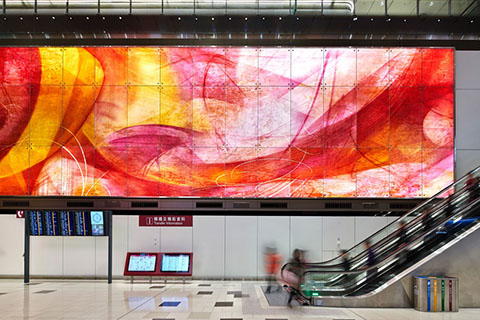
This technique involves genuine mouth-blown glass, which has a rich colour, texture and beauty unmatched by more contemporary methods, bonded to large sheets of float glass.  The antique glass has to be cut accurately to create a tight mosiac.  The technique enables the overall panels to be large, and creates a more fluid aesthetic without the required black outlines of lead.


honk kong airport

transparent enamels

These can be screen-printed, airbrushed or painted onto glass and then fired.  The glass can be transparent or etched.  The colours can be very rich and deep, though some specific colours cannot be achieved with these enamels.  There is something mysterious and alchemical about transparent enamels – they can be unpredictable when mixed and even show subtle changes in colour depending on whether you print on the tin side of glass or not!  Printing can be done one colour at a time, on one surface of a piece of glass only. The enamelled glass is fired in the toughening plant, thus the emerging product can be of any thickness and can conform to all building regulations.


st pancras

opaque enamels (fritted glass)

These are much more widely used commercially, the result frequently being referred to as ‘fritted glass’.  The opaque enamels are more predictable than transparent enamels, and can achieve almost any colour.   They show up equally from the interior or the exterior.  But, they are not same as transparent colours and, in my view, can seldom match them in subtlety and beauty.


john lewis, newbury

digital opaque enamels

These are essentially the same medium but, instead of being screen-printed onto the glass one colour at a time, they pass through an ink-jet system.  Thus a multicolour image can be created in a single process.  After printing the enamels are fired in the normal way making them completely permanent.  The process, as so often with the latest technology, is produced at much lower cost.


hornsby school

digitally printed interlayers

This process is a digitally printed film laminated between two panels of glass. The laminate material on either side of the glass provides a substantial, but not 100%, protection against degradation of the printed colours from daylight.


st johns wood

resin painted glass

This is a technique not widely used, but that has applications in certain contexts. Optimally the shapes are carved into glass with a sandblaster. This creates a perfect bonding surface for the resin as well as defined shapes for the colours. The colour is then poured or painted onto the surface of the glass. This resin brings the glass back to transparent, which makes the colours very striking. The colours can be very rich and can be mixed to create striking effects.


villa astana

slumped glass

Glass is heated over a mould to a temperature that allows the glass to slowly sag into a mould. Moulds can be created from many different materials giving many different effects. The availability of computer controlled kilns, that can heat and cool glass at controlled speeds, transformed this process from something complex and time consuming to something that can almost be done at the push of a button. The range of shapes, textures is infinite. The glass can be toughened. The technique creates a glass that is very textural and organic and works very well in older buildings as well as new.


ince residence

fused glass

This is a process where layers of glass are heated to quite high temperatures so that they fuse together. This can be done with coloured glass, powdered colours, layers of float glass, creating different shapes etc.


UKS

etched glass

Etching glass refers to both acid-etching and sand-blasting, both of which remove the transparency from glass by changing the surface. Acid etching is less used now as there are ceramic enamels which almost perfectly mimic the effect of acid etching. This means that repeated patterns can be created at very low cost, and a the effect is much more durable and scratch resistant than acid etching. Sandblasting is mainly a way of carving into glass and thus creating relief patterns.


eden house, bishopgate

dichroic glass

This is just one of many different types of glass on the market. Dichroic glass has a coating which means it is sometimes transparent and sometimes reflective and each mode reveals a different colour. Mostly the glass will be somewhere between these two extremes so the glass can reveal many different mixtures of colours. - or for short film here.